Plugging additional energy from alternative sources, such as wind and solar, into the current electrical system will require a smarter, more efficient power grid. Wei Qiao, a University of Nebraska-Lincoln assistant professor of electrical engineering, is working on the technologies needed for that smarter, next-generation power system.
MORE …
Author Archives: Sue Wesely
New Extension Ethanol and Biodiesel Workgroup launches Web site
 The Extension Ethanol and Biodiesel Workgroup started with the help of an energy education grant from the Nebraska Center for Energy Sciences Research. Go to http://bioenergy.unl.edu/ for information on agriculturally-based, sustainable energy sources including biofuels, ethanol co-product feeding, economics, economic development, cropping systems, water and biodiesel as these topics relate to the bioenergy industry. Go to http://bioenergy.unl.edu/forums.shtml for information on the monthly Biofuels Forum, which is presented over the internet. Previous forums are also archived at this site.
NCESR selects new research projects
Eleven new research projects were were selected for funding by the Energy Center in its fourth annual grant competition. To learn more, go to Energy Research Grants – Cycle 4.
Hudgins named NCESR associate director
UNL electrical engineering professor Jerry Hudgins became associate director of the Nebraska Center for Energy Sciences Research effective Aug. 1, 2009.
Hudgins is developing, coordinating and evaluating NCESR’s physical sciences research. This is a part-time appointment and Hudgins will continue his research and serving as chair of electrical engineering.
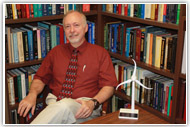 NCESR director Ken Cassman said Hudgins provides leadership and expertise in solar, wind and geothermal energy; energy storage and distributed power systems; architectural engineering; and energy conservation for commercial buildings and residences. Hudgins also leads UNL’s efforts to connect with industry and government agencies in these areas. MORE …
New Projects Funded through Water, Energy and Agriculture Initiative
Three new research projects were funded at UNL to maximize the efficiency with which water and energy resources are used to sustain economic development and water conservation in Nebraska agriculture. To learn more, go to Water, Energy and Agriculture Initiative.
Improvements in Life Cycle Energy Efficiency and Greenhouse Gas Emissions of Corn Ethanol
 Kenneth G. Cassman, Director of the Nebraska Center for Energy Science Research, and Heuermann Professor of Agronomy announced the paper on “Improvements in Life Cycle Energy Efficiency and Greenhouse Gas Emissions of Corn Ethanol” was published on the website of the Journal of Industrial Ecology for public access. This journal is the “gold standard” for publication of research on life cyle analysis of industrial and agricultural systems.
The results presented in this paper show that current corn-ethanol systems are much more energy efficient and have a much greater potential to reduce greenhouse gas emissions than previously published studies. The reason for this discrepancy is that, compared to the earlier studies, UNL’s research team utilized more recent data that better represent how the corn ethanol industry is currently performing. In particular, updated values were used for: (1) yields and inputs required for corn production, (2) energy requirements in the ethanol plant, and (3) a more accurate representation of how co-products are used in livestock diets.
The interdisciplinary team of researchers included agronomists, soil scientists, animal scientists and engineers, as well as feedback and input from industry. These researchers also presented data that shows there remains significant potential to further reduce greenhouse gas (GHG) emissions and improve energy efficiency. The UNL research team hopes the results from this research will contribute to efforts by the Environmental Protection Agency and state agencies with mandates to establish standards for estimating the GHG reduction potential of corn-ethanol systems. The paper presents the most up-to-date estimates of the direct-effect GHG emissions reduction and has the strongest underpinning science of all current estimates, especially because of the interdisciplinary approach used to perform the study.
Click here to read the paper on the web, or here to view the pdf
USDA and DOE Release National Biofuels Action Plan
 U.S. Department of Agriculture (USDA) Secretary Ed Schafer and U.S. Department of Energy (DOE) Secretary Samuel W. Bodman released the National Biofuels Action Plan (NBAP), an interagency plan detailing the collaborative efforts of federal agencies to accelerate the development of a sustainable biofuels industry. The NBAP was developed in response to President Bush’s plans, as described in the 2007 State of the Union Address, to change the way the United States fuels its transportation fleets. The president’s “Twenty In Ten” goal is to cut U.S. gasoline consumption by 20% over the next 10 years by investing in renewable and alternative fuel sources, increasing vehicle efficiency, and developing alternative fuel vehicles. (Source: EERE News, October 2008)
See the full text of the National Biofuels Action Plan, visit http://www1.eere.energy.gov/biomass/pdfs/nbap.pdf.
USDA and DOE Release National Biofuels Action Plan
U.S. Department of Agriculture (USDA) Secretary Ed Schafer and U.S. Department of Energy (DOE) Secretary Samuel W. Bodman released the National Biofuels Action Plan (NBAP), an interagency plan detailing the collaborative efforts of federal agencies to accelerate the development of a sustainable biofuels industry. The NBAP was developed in response to President Bush’s plans, as described in the 2007 State of the Union Address, to change the way the United States fuels its transportation fleets. The president’s “Twenty In Ten” goal is to cut U.S. gasoline consumption by 20% over the next 10 years by investing in renewable and alternative fuel sources, increasing vehicle efficiency, and developing alternative fuel vehicles. (Source: EERE News, October 2008)
See the full text of the National Biofuels Action Plan, visit http://www1.eere.energy.gov/biomass/pdfs/nbap.pdf.
Wind For Schools
The “Nebraska Wind Application Center” is being made possible at the University of Nebraska with funds from the National Renewable Energy Laboratory according to Dr. Jerry Hudgins, Head – Department of Electrical Engineering. Receiving an energy research grants from the Nebraska Center for Energy Sciences Research (NCESR) for Low-Cost Production of Hydrogen from Wind Sources started Dr. Jerry Hudgins, Head – Department of Electrical Engineering and his project team focusing on wind-related issues. As a direct result, Dr. Hudgins worked with the National Renewable Energy Laboratory and received $120,000 in total funding to develop the Nebraska Wind Applications Center to run the “Wind for Schools” in Nebraska. The project will receive $40,000 per year for the next three years. Click here for the Wind for Schools Program Overview. In addition to this wind work, Dr. Hudgins is the leader of the 21st Century Power Generating Systems focus area of The Future of UNL Energy Sciences Programs: 2007-2011 and the Principal Investigator for a second NCESR-funded research project titled The Viability of Wind Generation for Farm & Rural Communities.
New NCESR Videos
Click above to watch any of our new short videos: including an overview of the Energy Center, seven energy research projects and the Biofuel Energy Systems Simulator.