
NOW Accepting Applications: 2027 Summer Undergraduate Research Internships
Application deadline is Friday, November 13, 2026
The Nebraska Center for Energy Sciences Research (NCESR), chartered in 2006, supports innovative research and interdisciplinary collaboration by funding competitive “seed grants” for energy sciences research. About Us describes the mission, goal, vision, center organization and administration, including the Director, Associate Director, Executive Council and the External Advisory Committee. Contact Us gives the office address plus contact information for the Center’s staff. Use the Whittier Research Center Map or UNL’s Campus Maps to locate the NCESR office in Suite 230 of the Whittier Research Center, 2200 Vine Street, Lincoln, Nebraska.
Congratulations to the Darrell J. Nelson 2026 Summer Internship Recipients
Enhancing students’ research, critical thinking, and professional communication skills.
For the 13th year, NCESR offered a summer internship opportunity for undergraduate students in energy sciences research. To better align with undergraduate decision timelines, NCESR revised the application process by moving the application deadline and award notification to November–December 2025 instead of February–March 2026. Because many students accept summer internships by the end of December, this earlier timeline allowed undergraduates to apply before committing to other summer opportunities.
Each award recipient receives up to $6,000 to support their research work during the summer of 2026. Faculty sponsors may also request an additional $1,000 in travel funds to assist interns with expenses related to presenting their summer research at a relevant conference.
Interns and their faculty sponsors will participate in a meet-and-greet event in May with the NCESR team and NPPD liaisons. During this session, participants will learn about the work of NCESR and NPPD, as well as the history of NCESR and its summer internship program. Interns will also have the opportunity to share and discuss their research projects with fellow interns and faculty sponsors.
Additional summer activities include a tour of Cooper Nuclear Station, consistently noted by interns as a program highlight, and the presentation of a research poster at the UNL Summer Research Symposium in August 2026, where interns will compete for a $500 award recognizing the best NCESR summer intern poster. At the conclusion of the paid internship, each student will submit a summary report describing their accomplishments and/or research outcomes in energy sciences.
Through the collaboration between the University of Nebraska–Lincoln Summer Research Program (SRP) and NCESR, interns will have the opportunity to participate in seminars, workshops, and social events on the UNL campus, if interested. These activities provide opportunities to connect with students conducting research in other sciences, technology, engineering, and related disciplines and to build friendships with students from across the country.
The 2026 interns and their faculty sponsors are:
Morgan Hixson, Microbiology major with a Biochemistry minor
Faculty Sponsor: Dr. Nicole Buan, Department of Biochemistry
Calvin Sayre, Mechanical Engineering major
Faculty Sponsor: Dr. Alexei Gruverman, Department of Physics & Astronomy
Samarpan Mohanty, Computer Engineering major
Faculty Sponsor: Dr. Mona Bavarian, Department of Chemical & Biomolecular Engineering
Olivia Richler, Physics major with a Mathematics minor
Faculty Sponsor: Dr. Robert Streubel, Department of Physics & Astronomy
Trent Davidson, Electrical Engineering and Mathematics major
Faculty Sponsor: Dr. Jun Wang, Department of Electrical & Computer Engineering
Jorge Rivera Romero, Electrical Engineering and Mathematics major
Faculty Sponsor: Dr. Yanan (Laura) Wang, Department of Electrical & Computer Engineering
Kamilla Hera da Silva Pereira, Chemical Engineering major with a Chemistry minor
Faculty Sponsor: Dr. David Berkowitz, Department of Chemistry
Aram Pirali, Chemical Engineering major
Faculty Sponsor: Dr. Xia Hong, Department of Physics & Astronomy
The NCESR summer internship program is named after Mr. Darrell J. Nelson, who served 41 years on the Custer County Public Power District and NPPD Boards from 1970-2011 and advocated lifelong learning. In 2005, Mr. Nelson proposed a partnership between NPPD and UNL to engage in energy sciences research. The following year, NCESR was created with NPPD’s support.
Cycle 20 awards: Ushering in a new year of innovation
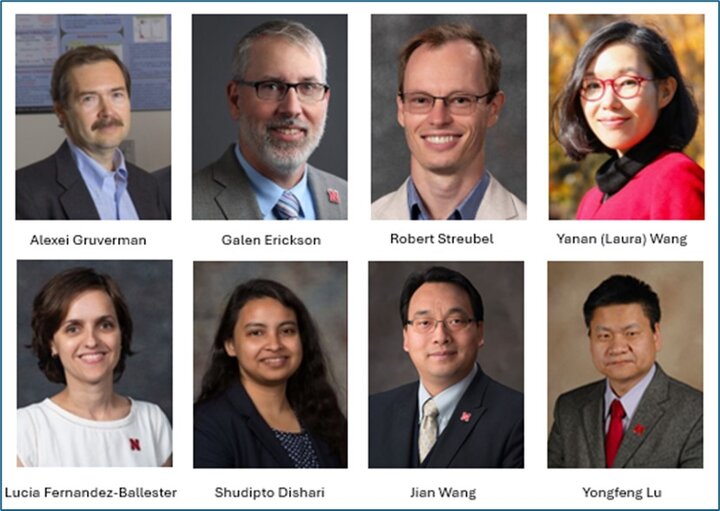
Eight new research projects have been selected for funding by the Energy Center in its twentieth annual grant competition. The funding started on January 1, 2026. The overall goal of the Nebraska Center for Energy Sciences Research (NCESR) is to foster research and education in energy sciences by providing funding to support innovative research and collaboration among UNL faculty and other public and private-sector organizations and businesses.
NCESR provides major funding for two-year research projects to UNL faculty through collaboration with the Nebraska Public Power District (NPPD). The NCESR funds enable UNL faculty to conduct innovative research to develop or enhance energy science and technologies and educate undergraduate and graduate students on various energy-related aspects. Faculty are required to use NCESR’s funding as a seed to pursue significant external funding. NPPD provides several letters of support for UNL faculty each year as they bid on federal grants (e.g., Department of Energy, Department of Defense, etc.). NCESR also awards annual summer internships for UNL undergraduates to conduct research under the guidance of a professor.
Enhanced Energy Storage using Antiferroelectric Hafnia-Based Dielectrics
Principal Investigator (PI) – Dr. Alexei Gruverman, professor of physics & astronomy, College of Arts and Sciences
Co-Principal Investigator (Co-PI) – Dr. Xiaoshan Xu, professor of physics & astronomy, College of Arts and Sciences
Abstract – With the global push towards renewable energy, there is a growing demand for efficient, high-density, and scalable energy storage technologies. Traditional dielectric capacitors face limitations in energy density and scalability. Antiferroelectric (AFE) hafnia (HfO₂)-based materials have recently gained attention for their high dielectric breakdown strength, excellent scalability, compatibility with Si-based fabrication processes (CMOS), and field-induced phase transitions that enable high energy storage densities. However, critical challenges remain in understanding their AFE phase stability and enhancing the energy storage performance.
The goal of this project is to develop AFE hafnia thin films with enhanced recoverable energy density. This goal will be achieved by pursuing several inter-related objectives aimed at (1) identifying the processing conditions, chemical dopants and electrode materials optimal for stabilization of the AFE phase; (2) conducting accelerated energy performance testing of hafnia capacitors under varying temperatures, frequencies, and electric field strengths to optimize the field-induced phase transition characteristics; (3) boosting the energy storage capabilities by reducing the leakage currents, enhancing the retention characteristics and benchmarking their performance against commercial dielectric materials.
Employment of AFE hafnia will result in disruptive innovation in the energy storage technology due to the drastically enhanced energy density as well as hafnia compatibility with CMOS technology, which enables hafnia integration both into microelectronic packaging and local energy supply systems.
Success of this project will enable development of resilient energy storage systems that would allow coping with the ever-growing energy consumption. Successful project implementation will provide a basis for attracting new funding from federal agencies (NSF, DARPA, NREL, DOE) and from semiconductor companies involved in development of energy storage technologies (Intel, Fluence, Matsushita, Siemens Energy). Both PIs have a strong track record of industry collaboration (Intel, Seagate, Toshiba, Fujitsu), which demonstrates their technical expertise and ability to deliver impactful results.
Improving circularity by replacing synthetic urea with soy and corn byproducts in feedlot cattle diets
Principal Investigator (PI) – Dr. Galen E. Erickson, Nebraska Cattle Industry professor of animal science & beef feedlot extension specialist, Institute of Agriculture and Natural Resources
Co-Principal Investigator (Co-PI) – Dr. Konstantinos Giannakas, Harold W. Eberhard Distinguished Professor of Agricultural Economics, Institute of Agriculture and Natural Resources
Co-Principal Investigator (Co-PI) – Dr. Jim MacDonald, professor of animal science and graduate committee chair, Institute of Agriculture and Natural Resources
Abstract – Cattle are commonly fed urea that microbes in the rumen convert to protein for the animal. The trade-off to using urea in feedlot diets is the negative impact of energy inputs required for manufacturing urea. This project will evaluate feeding urea to finishing cattle compared to natural protein sources originating from soybean or corn production. There is a strong indication that soybean production will increase due to demand for renewable diesel which will lead to a greater supply of soybean meal. Likewise, distillers grains may become more readily available and economical for cattle as non-ruminants displace distillers grains use with soybean meal. The cattle feeding experiment (year 1) will compare these protein sources for cattle productivity and carcass/meat characteristics, which allows for robust economic modeling in year two. In addition, a novel circularity model will be developed to evaluate the impact of diet ingredient choices and other management inputs on energy utilization, nutrient conservation, and economic dynamics resulting from byproduct utilization in integrated cropping-beef systems typical of Nebraska. We hypothesize that these opportunities are greatest in Nebraska where cropping and beef production are already aligned in many ways. Specifically, this project will work toward eliminating N inputs that are energy intense while enhancing bio-byproducts use in cattle feeding operations. Improving natural resource use by using byproducts for cattle production is a staple in Nebraska but we have not quantified the ‘circularity’ benefits or evaluated the energy balance of replacing urea. Quantifying these impacts is a critical outcome of this project and will allow us to expand on circularity of cropping-beef systems for things such as manure digestion, different housing systems to conserve nitrogen, precision manure nitrogen management, and others. This funding will provide baseline data to attract extramural funding in the future.
Materials development for combined neutron and alpha voltaics
Principal Investigator (PI) – Dr. Robert Streubel, assistant professor of physics & astronomy, College of Arts and Sciences
Co-Principal Investigator (Co-PI) – Dr. Peter A. Dowben, Charles Bessey Professor of Physics, College of Arts and Sciences
Abstract – The goal is to develop solid-state neutron and alpha voltaics, which provide both direct electric power generation and neutron radiation shielding at low cost using hydrogenated boron carbide semiconductors. A neutron voltaic creates voltage and current pulses from neutron absorption, much like a photovoltaic. Designing and testing a combined neutron and alpha voltaic device with efficient radiation capture and charge extraction, for the highest possible power product, requires exploring both diode and transistor geometry. This is because an alpha voltaic will work best in transistor geometry due to small penetration depth of alpha particles. The project exploits the strengths of Robert Streubel in device fabrication and frequency-dependent electronic transport and decades of boron carbide device development at the University of Nebraska. It includes materials synthesis, device integration, radiation testing, and optimization. The investigators seek to establish the foundations for neutron and alpha voltaics research, including the demonstration of significant zero-bias currents under neutron and alpha radiation, to become competitive for funding from the Office of Fusion Energy Sciences (OFES) within the U.S. Department of Energy (DOE) and to position the University of Nebraska for the anticipated Rads to Power (R2W) solicitation (DARPA-SN-25-78) from the Defense Advanced Research Projects Agency (DARPA) Defense Science Office (DSO). The team will refurbish an existing deuterium and tritium (D-T) neutron source, at the University of Nebraska, to offer in-house capabilities for the characterization of neutron and alpha voltaics in the Laboratory of Robert Streubel.
Polariton-Based Optical Neural Networks Toward Next-Generation Energy-Efficient Artificial Intelligence
Principal Investigator (PI) – Dr. Yanan (Laura) Wang, assistant professor of electrical and computer engineering, College of Engineering
Co-Principal Investigator (Co-PI) – Dr. Yinsheng Guo, assistant professor of chemistry, College of Arts and Sciences
Abstract – Remarkable progress in artificial intelligence over the past decade has transformed research and industry, driving breakthroughs in data mining, natural language processing, healthcare, finance, autonomous systems, cybersecurity, and more. The dominant AI systems rely on artificial neural networks (ANNs) implemented via software simulations that emulate the behavior of biological neural networks, such as the human brain. These simulations are executed on conventional von Neumann architectures, which increasingly face energy efficiency challenges with the exponential growth of data. The energy required for training and maintaining state-of-the-art AI models, especially large language models and deep learning networks, not only poses economic and environmental challenges but also raises concerns about long-term scalability and sustainability.
Toward next-generation energy-efficient AI technology, the collaborative team will explore an innovative approach that transitions from conventional software-based neural network simulations to physical systems where the neural architecture is directly implemented in hardware. Central to this project is the development of a nonlinear activation layer, a key component of optical neural networks, using the unique exciton-polariton properties of lead halide perovskite (LHP). Known for its large exciton binding energy and strong light-matter coupling, both heterogeneous and monolithic optical cavities will be developed to achieve room-temperature polariton condensation and nonlinear neuromorphic functionality utilizing this emerging quantum material (Years one & two). Built on these polariton platforms, an optical neural network (ONN) will be trained in a reservoir computing (RC) scheme (Year two). The performance of the proposed ONN will be benchmarked through the classification of handwritten digits, serving as a proof-of-concept for broader machine learning applications. This interdisciplinary project will pave the way toward scalable, ultrafast, and energy-efficient AI systems based on novel quantum photonic materials.
Femtosecond Laser Processing for Direct Bonding of Thermoplastics and Metals in Wind Turbines
Principal Investigator (PI) – Dr. Lucia Fernandez-Ballester, assistant professor of mechanical and materials engineering, College of Engineering
Co-Principal Investigator (Co-PI) – Dr. Craig A. Zuhlke, Richard L. McNeel Associate Professor of Electrical and Computer Engineering, College of Engineering
Abstract – Wind turbine blades are produced by bonding a small number of components with adhesives, but cracking and de-bonding of adhesive joints are major contributors to blade failure. Furthermore, thermoset composites are the typical material of choice for turbine blades, but thermosets cannot be repaired, be welded for joining parts, nor recycled into new blade components. There is currently increasing interest in switching to thermoplastic-based composites, which also exhibit excellent mechanical and stability properties but have potential to enable welding without adhesives, in-situ repairs, and recycling of blade materials. However, the high pressures and temperatures needed to weld thermoplastics are challenging to apply when joining large components, and bonding of thermoplastics to other materials is currently limited by poor adhesion and failure under mild loads. To overcome these challenges, the research objective of this proposal is to develop an innovative method to achieve strong adhesion of thermoplastic polymers through the use of an intermediate, femtosecond laser surface-processed metallic component. Well-controlled micro-and nano-structures will be created to induce superwicking and welding at mild conditions, with geometries tailored to resist the complex mechanical loadings expected during wind turbine service. This research will yield exceptional mechanical performance, decrease manufacturing costs, and allow in-situ repair and recycling of wind turbine blades.
Natural Polymer Electrolytes for Sustainable Batteries
Principal Investigator (PI) – Dr. Shudipto Konika Dishari, Ross McCollum Associate Professor of Chemical and Biomolecular Engineering, College of Engineering
Co-Principal Investigator (Co-PI) – Dr. Ozan Ciftci, Kenneth E. Morrison Distinguished Professor of Food Science & Technology, Biological Systems Engineering, Institute of Agriculture and Natural Resources, College of Engineering
Abstract – This project aims to develop safer, eco-friendly, efficient batteries using Nebraska’s abundant agricultural resources. The team will convert a plant-based material into advanced, safer, cheaper battery components to address key challenges and improve metal-ion battery performances. Such advancements can support efficient, cost-effective energy storage for consumer electronics, electric vehicles and transform grid-scale energy storage.
Corrosion Behavior of Galvanized Pipes Once Lead is Eliminated
Principal Investigator (PI) – Dr. Jian Wang, Wilmer J. and Sally L. Hergenrader Presidential Chair of Mechanical and Materials Engineering and graduate chair of materials engineering, College of Engineering
Co-Principal Investigator (Co-PI) – Dr. Bai Cui, professor of mechanical and materials engineering, College of Engineering
Abstract – Center-pivot irrigation systems are critical to agriculture in Nebraska, but a persistent problem is that their steel pipelines often begin leaking after only seven to 10 years of service. The primary cause is corrosion, which results from long-term exposure to water, dissolved minerals, chemicals, temperature changes, and sometimes microorganisms. Recently, pipeline operators have observed that corrosion appears to accelerate after lead was removed from galvanized (zinc-coated) pipes, raising concerns about reduced pipeline lifespan and increased maintenance costs.
Galvanization protects steel by applying a zinc coating that both blocks water from reaching the steel and corrodes sacrificially to protect the underlying metal. Historically, small amounts of lead were added during the galvanizing process because lead improves how well zinc spreads and adheres to steel. However, due to environmental and health concerns, modern standards have largely eliminated lead from galvanized coatings. While this improves safety, it may unintentionally reduce corrosion resistance.
This project aims to understand why galvanized pipes may corrode faster after lead removal and to develop effective, lead-free strategies to improve pipeline durability. The researchers hypothesize that lead indirectly slowed corrosion by improving coating quality and possibly influencing microbial activity on pipe surfaces. Without lead, zinc coatings may be more prone to breakdowns, localized pitting, or attack by corrosion-causing bacteria present in irrigation water.
The study will compare three types of pipelines: uncoated steel, galvanized steel with lead, and galvanized steel without lead. Laboratory corrosion tests will be performed using both purified water and real irrigation water from Nebraska. Based on our findings, the project will work with irrigation companies and utilities to develop practical lead-free solutions. The goal is to extend pipeline service life, reduce repair costs for farmers, protect water quality and strengthen the long-term reliability of Nebraska’s irrigation infrastructure—without reintroducing lead.
Fabrication and Diagnostics of Fuel Targets for Laser-driven Inertial Confinement Fusion
Principal Investigator (PI) – Dr. Yongfeng Lu, Lott University Professor of Electrical and Computer Engineering, College of Engineering
Co-Principal Investigator (Co-PI) – Dr. Bai Cui, professor of mechanical and materials engineering, College of Engineering
Abstract – This research aims to improve laser-based nuclear fusion by developing better ways to create and inspect the tiny fuel targets used in experiments, supporting the U.S. Department of Energy’s efforts to advance clean fusion energy. Turning fusion into a practical source of unlimited clean power still faces big hurdles. One key issue is reliably making the precise fuel targets and checking the frozen fuel layer inside them at extremely cold temperatures before the laser shot. To tackle this, the project proposes using two cutting-edge tools: a high-precision 3D printing method called two-photon polymerization to build better targets, and an advanced imaging technique called cryogenic coherent anti-Stokes Raman scattering to create detailed 3D views of the targets and fuel under those freezing conditions.
Cycle 19 research projects secure Year 2 funding

To determine the projects that receive Year 2 funding, the NCESR Progress Review Committee reviewed the Cycle 19 Principal Investigators (PIs) six-month reports, and each PI presented to the committee on October 15, 2025. The review allowed the committee and PIs to discuss the progress of each project in more detail. The Progress Review Committee is comprised of the NCESR Director and Associate Director, NPPD Liaisons and NUtech staff. The committee meeting also allows NUtech to connect with the PIs and Co-PIs, if they haven’t already, regarding disclosures and intellectual property (IP). Following committee deliberations, all five Cycle 19 projects received Year 2 funding, which began on January 1, 2026.
We look forward to receiving future updates regarding their research progress, external funding awards, and any IP results.
Enhanced CO2 transport for high-efficiency biological carbon capture and biofuel fermentation
Principal Investigator (PI) – Dr. Nicole Buan, professor of biochemistry, Institute of Agriculture and Natural Resources
- Co-Principal Investigator (Co-PI) – Dr. Siamak Nejati, associate professor of chemical and biomolecular engineering, College of Engineering
Innovative Approaches to Sustainable Agriculture: Greening Ammonium Sulfate Production
PI – Dr. Mona Bavarian, assistant professor of chemical and biomolecular engineering, College of Engineering
- Co-PI – Dr. Yașar Demirel, professor of chemical and biomolecular engineering, College of Engineering
- Co-PI – Dr. Javed Iqbal, associate professor of agronomy and horticulture, Institute of Agriculture and Natural Resources
Enhanced Hydrogen Generation and Utilization using Femtosecond Laser-nanostructured NiCo2O4 Electrocatalysts
PI – Dr. Yongfeng Lu, Lott Distinguished University Professor of Electrical Engineering, College of Engineering
- Co-PI – Dr. Bai Cui, professor of mechanical and materials engineering, College of Engineering
- Co-PI – Dr. Vitaly Alexandrov, Richard L. McNeel Associate Professor of Chemical and Biomolecular Engineering, College of Engineering
Innovative Solutions for Data Center Thermal Management: Oxide-Free Femtosecond Laser Processed Copper Surfaces
PI – Dr. Graham Kaufman, research engineer, research assistant professor of electrical and computer engineering, College of Engineering
- Co-PI – Dr. Craig Zuhlke, Richard L. McNeel Associate Professor of Electrical and Computer Engineering, College of Engineering
- Co-PI – Dr. Jeffrey Shield, department chair, Robert W. Brightfelt Professor of Mechanical and Materials Engineering, College of Engineering
Advanced manufacturing of high-temperature alloy components for small modular reactors
PI – Dr. Bai Cui, professor of mechanical and materials engineering, College of Engineering
- Co-PI – Dr. Yongfeng Lu, Lott Distinguished University Professor of Electrical and Computer Engineering, College of Engineering
Celebrating 20 Years of Excellence
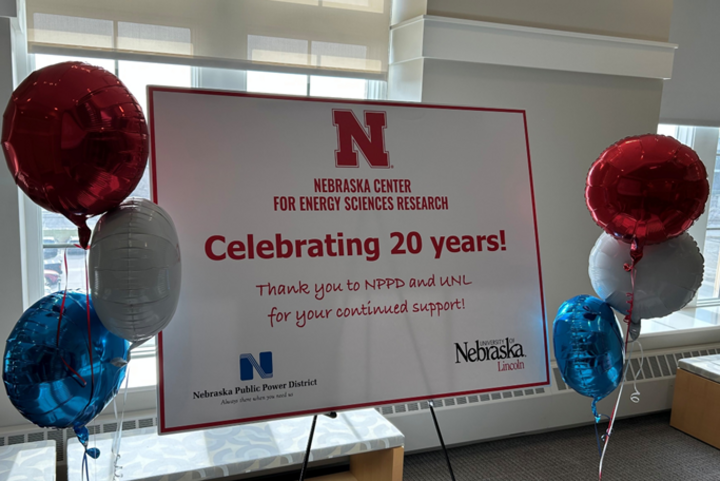
In advance of the December 9, 2025, NCESR External Advisory Committee Meeting, the Energy Center hosted a luncheon to celebrate the center’s 20th anniversary. NPPD research liaison Alan Dostal provided a review of the formation of the Energy Center, which was the brainchild of then NPPD Director Darrell J. Nelson. This led to early discussions with then UNL Chancellor Harvey Perlman, Vice Chancellor for Research & Economic Development Prem Paul, and other staff from UNL and NPPD. The agreement between NPPD and UNL was made effective on April 1, 2006.
Alan Dostal went on to review the distinguished list of Energy Center Directors who have led the Energy Center since its inception. They include founding Director Dr. Ken Cassman, Dr. Mike Nastasi, Dr. Jerry Hudgins, and current Director Dr. George Gogos and Associate Director Dr. Mark Riley. Mr. Dostal also provided information on the academic benefits derived from the collaboration, citing the popular Darrell J. Nelson Summer Research Internship Program. He also cited the economic benefits derived from the Energy Center’s work on renewable fuels and the resulting byproducts such as wet distillers grain for cattle feed. Also noted were contributions from research in materials science, electronics, and other bioenergy technologies. The partnership between NPPD and UNL has been renewed for another five years, which marks NPPD’s 25-year commitment to energy-related research with UNL.